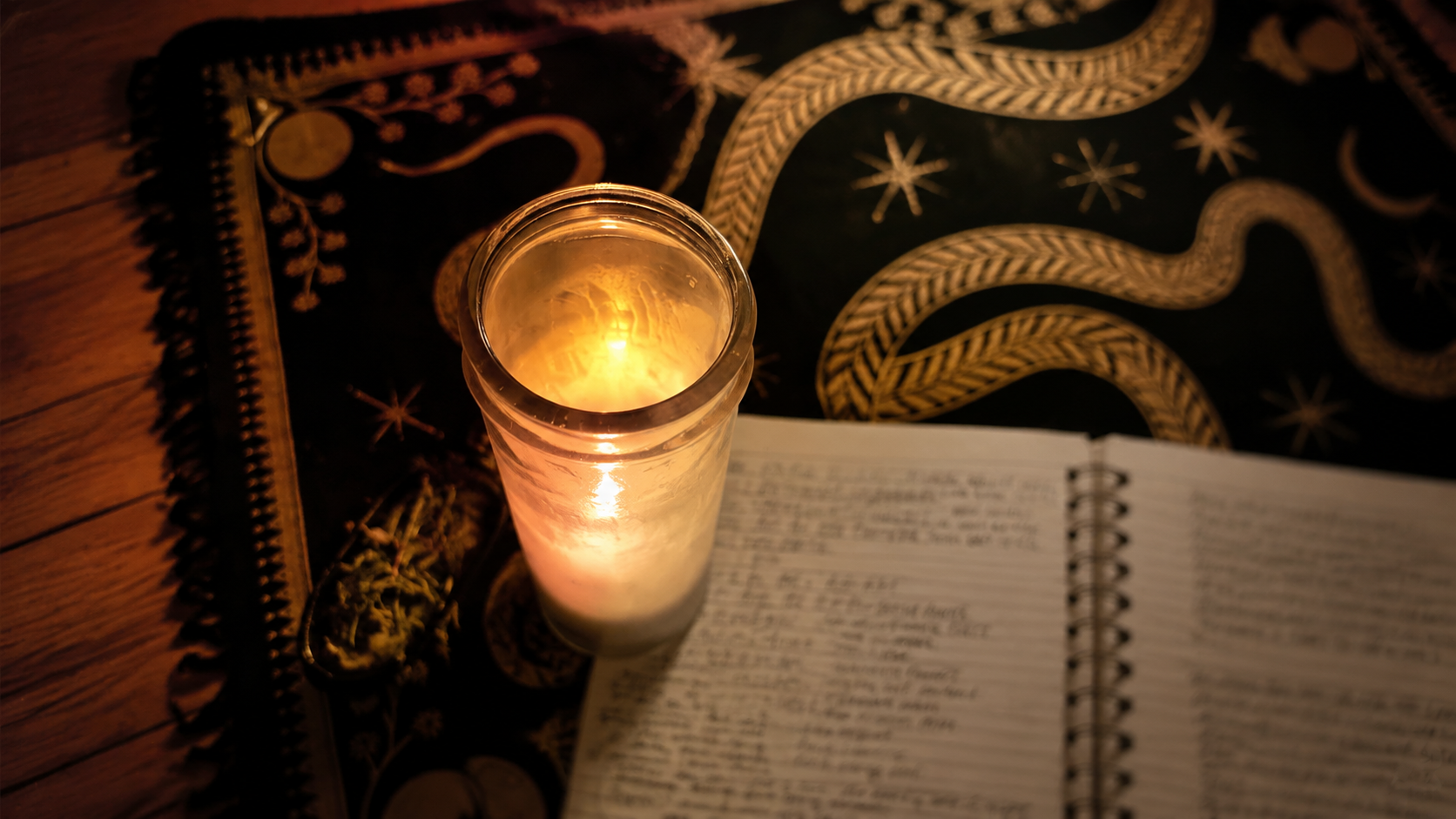
Before You Cast the Spell
I think most people who turn to spellwork, witchcraft, divination, or some form of occult practice do so out of pain. If it’s not something you grew up with, if your nanny wasn’t planting by the signs or your mom wasn’t lighting candles and saying Psalms over an ill relative, the occult isn’t your usual remedy when you reach a point in life where nothing eases your troubles.
Maybe you’ve lost your job and, for whatever reason, can’t seem to find another one. Maybe you lost the love of your life and can’t get them back. Maybe a loved one passed on, and you’re desperate to speak with them again. In most cases, I think you’ve exhausted all the standard options.
So what do you do when every force seems to be conspiring against you? What do you do when your luck, if you ever had any, has run out?
You get it back by metaphysical force.
Build a mojo hand for prosperity. Carve sigils into a candle and burn it on an altar surrounded by the proper herbs. Write a petition and burn it. Cast a spell or perform the ritual spellwork of the Golden Dawn or Thelema. You put all your new energy, all that power, into a spell to achieve what you want.
But the real question is: Should you?
One of the most important things I’ve learned through practicing witchcraft is that being able to do a spell doesn’t mean that I should.
Spells are often presented as the defining feature of witchcraft. There seems to be a working for everything: love, money, protection, justice, road opening, banishing, healing, reconciliation, and success. If something’s wrong, the obvious response appears to be lighting a candle, filling a jar, dressing an object, or speaking an intention over a handful of herbs.
But witchcraft is not simply a collection of ways to make things happen. It’s also the practice of knowing when to act, when to wait, when to protect yourself, and when to accept that something has reached its natural end.
A Spell Creates Movement
I believe spells can create movement. I also believe movement has consequences.
That doesn’t necessarily mean some universal force will punish you for casting the “wrong” spell. I don’t believe that. I don’t prescribe to the threefold law of return. I believe the consequences are often much more practical. It’s like making wishes with a genie. You may get exactly what you wish for, and it may not be at all what you need.
If you ask for the truth, you may learn something you cannot unlearn. If you ask for a road to open, something currently occupying that road may have to move. If you ask for justice, the situation may be corrected in a way that is uncomfortable for everyone involved, including you.
A protection working may strengthen a boundary, but it may also reveal who resents that boundary. A banishing may remove the immediate problem while leaving you responsible for whatever comes next. A cord cutting may help you release someone, but it can’t promise that you will never grieve the relationship again.
The working may succeed without producing the outcome you pictured. When you create movement, you leave an absence behind. Something must take its place. That is simply how energy and properly considered transmutation work. If you are inexperienced and move something from one place to another, are you prepared for what may happen as a result?
This is why I try to ask more than, “Will this spell work?”
I also ask:
- What would success actually look like?
- What might have to change for this intention to take form?
- Am I prepared for that change?
- Am I acting from clarity, or am I reacting from fear, anger, grief, or impatience?
- Have I done what can be done in ordinary, practical ways?
- Is this situation mine to influence?
Those questions have stopped me from doing more spells than they have encouraged me to begin. I consider that a sign of growth.
Magic Should Not Replace Practical Action
I don’t believe a spell should be used to avoid a conversation, a decision, a doctor, a lawyer, a budget, a locked door, or a clearly stated boundary.
Protection magic doesn’t replace securing your home. Prosperity work doesn’t replace examining where your money is going. Healing work does not replace appropriate medical care. A road opening spell can’t help much if you refuse every available road because it doesn’t look exactly like the one you wanted.
Sometimes the most powerful thing you can do is make the phone call, submit the application, leave the situation, say no, tell the truth, take accountability, or go to bed and reconsider everything in the morning.
Practical action and spiritual work can support each other. They shouldn’t be forced to compete.
Intention Is Not the Same as Readiness
I have heard many people say that intention is everything, but I just don’t agree. Intention matters, but so do judgment, timing, preparation, emotional state, materials, method, and the willingness to take responsibility for the result.
I can sincerely intend to protect myself while actually feeding my fear. I say that from experience. What began as a desire to protect myself, my business, my home, and my energy turned into something that drained me.
I can call something justice when what I truly want is revenge. That is simply a matter of perspective if I’m not capable of seeing my own contributions to the situation.
I can ask for clarity while secretly hoping only to have my existing beliefs confirmed. Truth is often painful. If I’m only open to answers that make me feel better, I will not grow from what I learn.
I can perform a release working while continuing to check whether the other person has noticed my absence. A release working should free both people. How can it do that if my attention remains fixed on the very thing I want to release?
The words spoken during a spell don’t automatically override the truth beneath them.
Before I do a working, I try to identify what I am really asking for. Not the polished version. Not the version that sounds spiritually mature. The honest version.
Sometimes that honesty confirms the working. Sometimes it changes the working. Sometimes it shows me that I shouldn’t do one at all.
Not Every Uncomfortable Feeling Requires Intervention
This has been one of the harder lessons for me.
Discomfort can create an urgent desire to do something. I am a doer. I do not sit still. If something is wrong, I fix it. If something is not moving fast enough, I push it. When a situation feels uncertain, spellwork can offer a sense of participation and control. It can make us feel as though we’re moving when we’re actually avoiding the important questions.
But uncertainty isn’t always a spiritual problem to solve. Neither are grief, longing, anger, or disappointment. Those feelings may need to be witnessed rather than transformed immediately.
Sometimes repeated workings keep our attention tied to the very thing we say we want to release. We light another candle, pull another card, ask another question, or change the ingredients, as if the right combination will finally make reality give us a different answer.
There are times when the wiser practice is to put everything down.
Let the first working stand. Stop interfering with it. Allow the situation to reveal itself. Make room for your own emotions to settle before deciding what they mean.
Restraint is a big part of witchcraft. More often than not, the working you think isn’t working is still moving. The spell you cast that seemed to produce no result may be moving slowly or in a way you didn’t expect, but it will continue working toward the action you requested. Be sure before you ask for it. A month from now, when the anger has cooled and your mind has changed, it may be too late to stop its effects.
Consider Who Else Is Involved
This is probably the most important consideration before spellwork. Any spell concerning another person deserves additional thought. When you have thought about it, think about it some more.
It’s easy to justify interference when we believe we know what would be best. We may tell ourselves that we are helping someone recognize the truth, return to the right path, make contact, change their mind, or behave differently.
But wanting a particular response from someone does not give us ownership of their choices. We are not gods.
Personally, I am much more comfortable working on my own position within a situation through protection, clarity, courage, discernment, release, strong boundaries, or the opening of whatever path is genuinely right for me. Those workings do not require me to decide what another person should feel or do.
That does not mean every tradition shares identical rules about influence, justice, binding, or defensive magic. Witchcraft does not have one universal moral code. Still, “My tradition permits this” and “This is wise for me to do” are not always the same answer.
There Is Still a Time for Spells
None of this means that I believe spells should never be used. I practice witchcraft because I believe spiritual work can matter.
I have found value in workings that protect a home, establish a boundary, consecrate an object, support healing, clear away stagnant energy, honor the dead, strengthen courage, or mark a meaningful transition. A spell can give physical form to a decision. It can help align the mind, body, spirit, and environment around an intention that’s already supported by real action.
The strongest workings in my own practice haven’t felt like attempts to force the world into obedience. They feel like clear statements:
This is what I am choosing.
This is what I am willing to do.
This is what I will welcome.
This is what I will no longer carry.
That kind of spell doesn’t relieve me of responsibility. It makes the responsibility harder to avoid.
Knowing When Is Part of the Craft
Learning ingredients and methods is useful. Learning correspondences is useful. Understanding timing, preparation, and tradition is useful.
But discernment is what holds all of it together.
There is a time to cleanse and a time to recognize that an environment keeps becoming unsettled because nothing within it has actually changed. There is a time to protect and a time to leave. There is a time to call something toward you and a time to question why you are chasing it. There is a time to seek an answer and a time to live according to the answer you have already received.
Sometimes you need the spell. Sometimes you need the boundary, the conversation, the consequence, or the rest.
Sometimes the most honest act of witchcraft is deciding not to interfere.