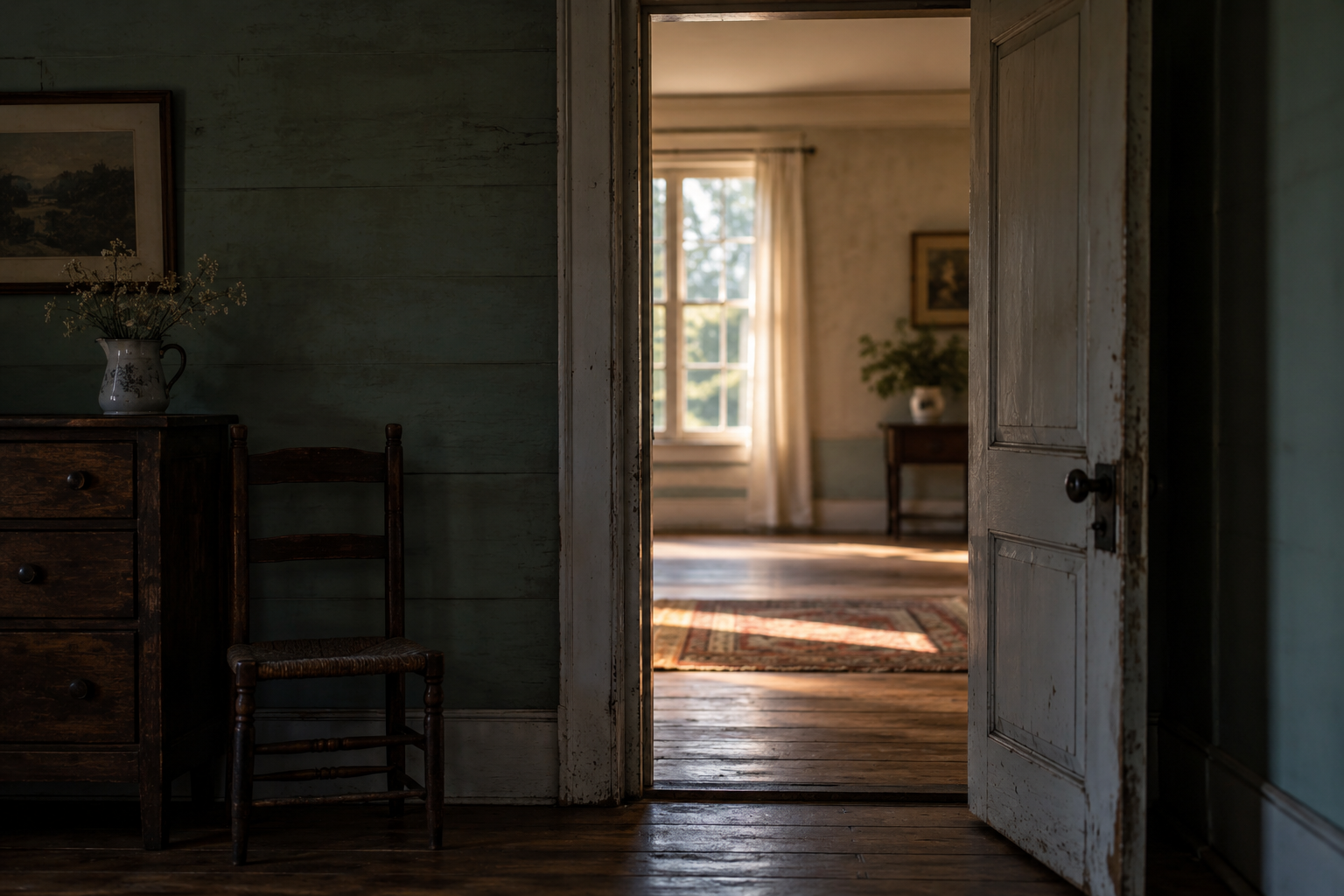
The Rooms We Leave Haunted
The Lantern Society’s investigation into thresholds got me to thinking about what it means to be haunted.
Not whether ghosts exist. I settled my own feelings about that question a long time ago. I mean something more difficult to define: how something can be gone and yet still remain.
We talk about hauntings as though they belong to houses, battlefields, cemeteries, old hotels. Places where something so intense happened that it left an energetic impression behind.
A door opens where no one is standing.
Footsteps cross an empty room.
Someone catches the scent of a perfume that hasn’t been worn there in fifty years.
Whether we interpret those things as spirits, memory, coincidence, or something we don’t yet have language for, the idea beneath them is the same. Something happened here and somehow, the place remembers.
But I don’t think buildings are the only things that can become haunted. People can, too. And not necessarily in spectral ways, but with the tendrils of lost connections that never quite seem to release you from their grasp.
Relationships That End at a Threshold
There are relationships that end neatly enough. The last words are spoken. The reasons are understood. Eventually, each person walks away carrying roughly the same knowledge of what happened.
And then there are relationships that end at a threshold. One person crosses it, moves on, walks away. And the other is still inside the house.
No final conversation. No mutual accounting of what happened. No moment when everything is laid on the table and examined in daylight rather than darkness.
Just absence.
And at first, absence feels like anything but an ending. It’s an interruption. You think, this isn’t over, just give it time. But give it too much time, and you’re waiting forever for someone who will never look back.
You may think there will eventually be another conversation. Not necessarily one that restores what existed before because time changes too much for that. But maybe one that allows two people to return to the ruins and finally understand what happened there. To make peace, to make amends, to wish each other well.
So you leave the door open. Maybe you even hover around that threshold, and because you’re standing there every movement of air feels significant.
You revisit conversations. You reconsider things you once felt certain about. You discover places where you were wrong. You understand things far too late. You type texts you’ll never send, compose sentences that have nowhere to go.
Sometimes you become capable of having the conversation you should have been capable of having in the first place. You grow, and learn, and you know how to handle it.
But there is a cruel difference between becoming capable of repairing something and being given the opportunity to repair it.
What We Put Into Silence
I thought enough reflection might eventually produce resolution. If I could understand what happened completely enough—my part, the other person’s part, all the strange machinery underneath it—then maybe I could find the missing piece that would make everything just settle into place.
But some questions only have answers that belong to other people. And sometimes those people choose silence.
Silence is such a strange thing. It creates an empty space your mind desperately wants to fill.
We fill it with expectations, hope, fear. We imagine conversations and motivations and endings. We search backward through memory looking for the moment when everything changed, as though somewhere there must be a loose floorboard we can lift and finally discover what has been hidden underneath.
Eventually, though, the search itself becomes another kind of haunting.
You aren’t just remembering what happened anymore. Now you’re walking that same long corridor again and again, listening for footsteps.
The Residual Haunting
Sometimes I wonder if this isn’t how residual hauntings form.
In paranormal folklore, a residual haunting isn’t a conscious spirit trying to communicate, it’s more like an event caught in repetition: footsteps on the stairs, a figure crossing a hallway, a sound occurring at the same hour.
Nothing new is happening. Something old is simply happening over and over, like a video loop.
Memory can behave exactly like that.
You’ll relive a conversation, a particular day, a smile. And you’ll strain to reach back and touch that version of yourself who didn’t yet know what was about to happen. You’ll warn them, tell them to do it all differently.
For a moment, the past can become the present. And then, just as fleetingly, it’s gone.
That’s what happens when you stand in that doorway, waiting. You know you should close the door because leaving it open allows those ghosts to pass through whenever they wish.
Healing Doesn’t Have to Be an Exorcism
But healing doesn’t have to be an exorcism.
We don’t need to drive every ghost from the house. Some things just mattered too much to disappear without leaving a trace.
Those are people who permanently alter the architecture of our lives. They show us rooms we didn’t know existed. They move walls. They open windows. Sometimes they break things. Sometimes we break things ourselves.
And when they leave, the building doesn’t just suddenly return to its original floor plan.
You’re left with the alterations and the mess.
I used to think acceptance meant closing the door, but I don’t anymore. There are doors I don’t particularly want to lock. Not because I intend to spend my life waiting for someone to walk through them, but because I don’t need anger to guard the entrance.
There is a difference between leaving a door unlocked and standing beside it.
That may be the hardest thing I have learned.
You can stop waiting without deciding that you never cared. You can acknowledge your own mistakes without accepting responsibility for everything that happened. You can wish you had done things differently without believing you deserve to remain indefinitely inside the consequences.
You can forgive someone who has never asked to be forgiven. You can even leave room for a conversation that may never happen.
But eventually, you walk away from the threshold because the rest of the house is still there.
Living With Ghosts
There are windows you haven’t opened yet. Rooms you haven’t entered. People knocking at other doors. A whole world continuing outside while you’ve been listening for one particular set of footsteps.
Maybe that’s the difference between being haunted and living with ghosts.
Being haunted means the past still determines where you can go. Living with ghosts means knowing exactly where the past resides and continuing to build a life around it.
I don’t know whether every unfinished story eventually receives an ending. Maybe some doors reopen years later, and others don’t. Maybe some people return when we have stopped expecting them, and maybe some become people we used to know, no matter how impossible that once seemed.
There is no ritual that can tell us which kind of story we are living while we are still inside it.
The only thing we can do is stop asking the doorway for an answer.
Leave it unlocked, if that feels right.
Turn off the light.
And go live in the rest of the house.